
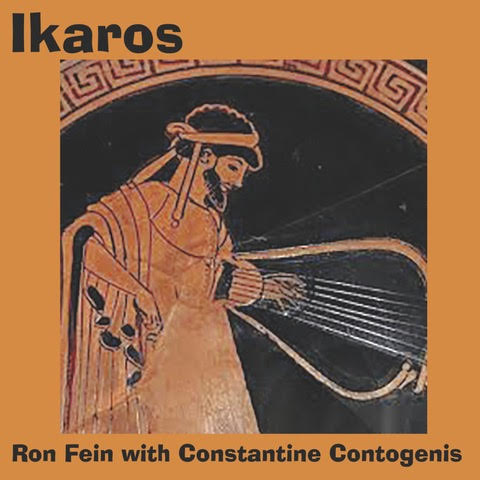
The lore of Ikaros (Icarus) and my collaboration with the
poet Constantine Contogenis, whose family home is on
Ikaria – the Greek island connected to the mythology – is at
the heart of this album. He has also translated poetry by
Constantine Cavafy which I have set here. The music seeks
to capture a sense of antiquity, through what is known and
what can be imagined. I have created sounds, gestures,
rhythms and syntax, both instrumental and vocal, toward
reconstructing and dreaming this past. – RF
1 – The Calf Borne (1:33) – Contogenis.
2 – Ikaros (8:53) – Contogenis.
3 – People Gossip (1:42) – Sappho.
4 – Ithaka (4:42) – Cavafy.
5 – Charioteer (2:37) – Homer.
6 – To Sappho (6:29) – Sappho, Contogenis.
7 – The God’s Final Words to Antony (5:37) – Cavafy.
8 – Waiting for the Barbarians (5:01) – Cavafy.
9 – Four Epitaphs (6:28) – Unknown, Cavafy.
10 – When They Emerge (4:53) – Cavafy.
Constantine Contogenis is a poet and translator, winner of
the Open Voice Poetry Award, author of Ikaros, Songs of the
Kisaeng, Our Cavafy (2026), and Between One Thing and Its
Other (2026). Published in Paris Review, Pequod, Chicago
Review, Yale Review, other prominent poetry magazines, and
the anthology Joining Music with Reason.
All translations of Cavafy are by Constantine Contogenis,
and are in his forthcoming book: Our Cavafy. His original
poems on the album are: The Calf Borne, Ikaros, and Idle
Sapphics.
To Sappho contains two Sappho retranslations which I have
made, and then Idle Sapphics by Constantine Contogenis,
beginning with: “Nice for you, this telling the truth…” Four
Epitaphs contains three ancient unknown epitaphs, which I
have retranslated, and the fourth is Desires by Cavafy,
beginning with: “The beautiful dead…” – RF
Ancient Greek music was not as sophisticated as literature of
the time, as in the writings of Homer or Aristotle. What
sounds slightly out of tune with western sound is due to
primitive and inconsistent tuning systems, and a lack of the
ability to notate efficiently. I have used historical references
to reconstruct what instruments, ensembles and accompanied
readings might have sounded like: cultured but unrefined to
the modern ear.
Working with the album as a finished offering, it began to be
clear that a pre-mechanized and completely human sense of
time was being embraced. Musical phrasing breathes as if
made in antiquity, in a rhythm abandoned of celerity, but
spacious. Constantine’s poetic work fits perfectly with this
scenario, due to its earthiness, intelligence, and Greek
historical heritage. Recitations are conveyed with clarity and
sagacity. All of this adds, I believe, to appreciating this music
through the eyes of history.
Notes on Ikaros by Constantine Contogenis: This poem
follows the myth of Ikaros (Icarus), son of Daedalos
(Daedalus), the inventor. In Athens, Daedalos took his
nephew on as an apprentice. But fearing he was teaching him
too well, Daedalos pushed him off a high wall to his death.
Fleeing to Crete, Daedalos entered the service of King
Minos. The king, fearing himself too well served by
Daedalos, imprisoned him with his son. Daedalos invented
wings for their escape, but warned his son not to fly too high
or low. Ikaros flew so close to the sun, the wax on his wings
melted, and he fell to his death off the coast of what came to
be called Ikaria.